
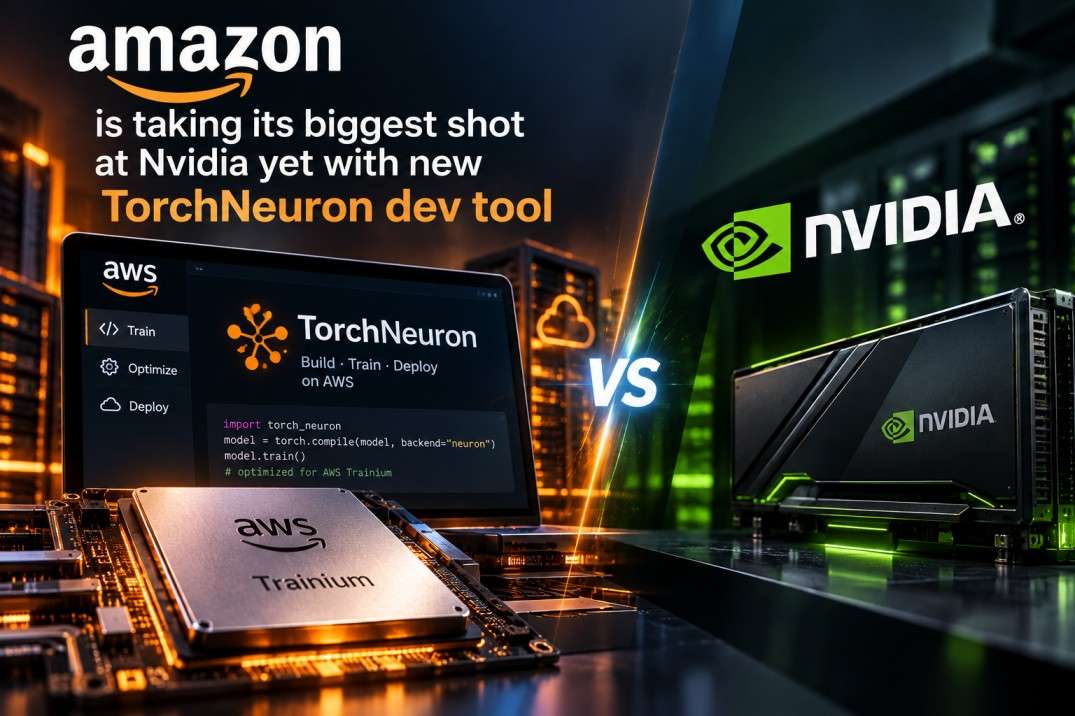
Cracking the CUDA Moat: Why Amazon’s Open-Source TorchNeuron Is Its Direct Shot at Nvidia
For years, Silicon Valley has known an open secret about Nvidia’s near-monopoly on artificial intelligence: it was never just about the silicon.
Anyone with enough capital can fabricate high-bandwidth memory and tape out accelerated computing chips. What kept the entire AI world tethered to Nvidia was CUDA—the proprietary software ecosystem that millions of machine learning engineers have spent over a decade writing their code around. Leaving Nvidia meant facing a brutal, months-long engineering rewrite to make models run on rival chips.
Amazon Web Services is making its most aggressive push yet to dismantle that lock-in.
Through its Annapurna Labs chip unit, Amazon has released TorchNeuron as a free, open-source tool under the Apache 2.0 license. Its pitch is deceptively simple: take your native PyTorch code and run it directly on AWS Trainium chips with a single configuration change—no rewriting required.
The Real Battle: Developer Friction
Roughly 85% of AI researchers and developers write their models in PyTorch. Up until now, moving an existing PyTorch workload from Nvidia GPUs to custom cloud silicon—like Amazon’s Trainium or Inferentia—felt like translating an entire novel by hand. Compilers failed, custom CUDA kernels broke, and engineering teams decided the lower cloud-compute bill wasn’t worth the migration headaches.
TorchNeuron acts like an automated adapter. Instead of demanding that developers adopt a bespoke programming environment, Amazon met them where they already build.
Key pieces of the launch:
* Zero-Rewrite Execution: PyTorch code runs natively on Trainium silicon with virtually identical model definitions.
* Ecosystem Backing: Meta’s PyTorch engineering team endorsed the move, working with Amazon to reduce hardware-specific hooks in the PyTorch upstream repo.
* Native Hugging Face Integration: Support has been folded directly into widely used open-source libraries like Hugging Face Transformers and Diffusers, letting developers pull pretrained models straight into Trainium environments.
* Early Momentum: Over 30 enterprise teams—spanning robotics, voice agents, and world models—are already utilizing the backend to train and serve workloads.
Why AWS Needs Trainium to Win
Amazon is still buying billions of dollars worth of Nvidia GPUs every quarter—and will continue to deploy millions of them over the coming years. But reliance on a single hardware vendor has cratered hyperscaler margins and left cloud providers at the mercy of Nvidia’s supply allocations and pricing power.
By lowering the switching costs between GPUs and Trainium, AWS is trying to change the rules of cloud computing.
If code becomes truly portable across silicon, customers no longer pick a cloud provider based on who secured the latest allocation of Blackwell or Hopper chips. Instead, cloud platforms can compete on pure price, throughput, and availability. For startups burning millions in compute every month, shaving 30% to 50% off training bills simply by changing a configuration flag is an offer few CFOs will ignore.
The Takeaway
Nvidia’s moat has withstood dozens of challenger chips because nobody had cracked the developer workflow barrier.
With TorchNeuron, Amazon isn’t asking the AI community to abandon PyTorch or learn a whole new software stack. It is making custom silicon an invisible backend detail.
If switching from Nvidia to Amazon silicon is genuinely as easy as changing one setting, the AI hardware market is about to get a lot more competitive.