
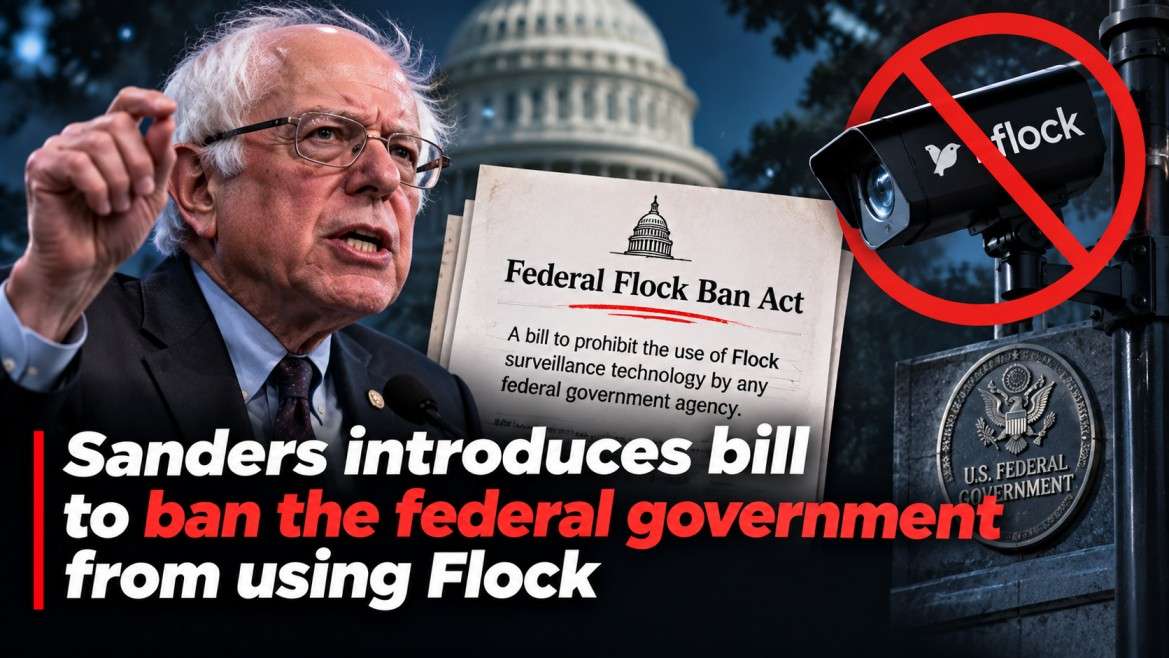
**Capitol Hill Takes on ALPRs: Sanders and AOC Introduce the ‘Ban Flock Act’**
Pushback against private surveillance networks has officially reached Congress. Following judicial warnings that automated license plate readers (ALPRs) constitute “indiscriminate mass surveillance,” Senator Bernie Sanders (I-VT), alongside Senator Jeff Merkley (D-OR) and Representative Alexandria Ocasio-Cortez (D-NY), has introduced landmark legislation aimed directly at cutting off the technology’s federal expansion: the **Ban Flock Act**.
The proposed bill takes direct aim at **Flock Safety** and the broader automated vehicle-tracking industry, seeking to bar federal agencies from acquiring or tapping into massive ALPR networks without explicit, narrow authorization from Congress.
—
### What the ‘Ban Flock Act’ Actually Does
Rather than treating automated plate scanning as routine traffic monitoring, the legislation treats nationwide vehicle-tracking databases as dragnet surveillance. Key provisions of the bill include:
* **Strict Federal Ban:** Prohibits federal agencies and officials from acquiring, accessing, possessing, or utilizing ALPR systems or third-party vehicle databases.
* **No End-Runs Around Congress:** The federal government cannot tap ALPR data unless an Act of Congress explicitly authorizes the specific agency, sets strict use-case boundaries, and mandates retention windows of no more than 48 hours.
* **Cutting Grant Funding:** Restricts federal grants and funding programs to state and local law enforcement agencies that continue deploying ALPR technology.
* **Evidence Suppression:** Mandates that any data obtained in violation of the Act is strictly inadmissible in federal criminal, civil, or administrative court proceedings.
* **Private Right of Action:** Gives individual citizens the explicit legal standing to sue the federal government if their vehicle data is unlawfully tracked or accessed.
—
### Why Lawmakers Are Escalating
The bill arrives amid mounting scrutiny over how private surveillance vendors operate:
1. **Circumventing Warrants:** Federal agencies like ICE, the FBI, and the DEA have increasingly relied on commercial data brokers and local police sharing agreements to bypass Fourth Amendment warrant requirements.
2. **Interstate Dragnet Risk:** Civil liberties advocates warn that centralized plate databases can be weaponized across state lines—such as tracking individuals traveling for reproductive healthcare or monitoring lawful political protests.
3. **The Erosion of Public Anonymity:** When cameras capture billions of plate reads every month, driving down a public road ceases to be anonymous; it becomes a perpetual, searchable digital breadcrumb trail.
—
### The Pushback and Industry Defense
Flock Safety and law enforcement groups argue that ALPRs are critical investigative tools responsible for solving homicides, recovering stolen vehicles, and finding missing children through Amber Alerts. Industry proponents argue that banning the tech wholesale throws out vital public safety infrastructure rather than refining its audit and governance standards.
However, lawmakers sponsoring the bill contend that utility cannot come at the cost of constitutional protections. As Sanders warned upon introducing the measure, unchecked commercial camera networks are accelerating a slide toward an unaccountable surveillance state.
—
### The Takeaway
By targeting both federal usage and the federal grant dollars that local police departments use to purchase cameras, the Ban Flock Act is the most aggressive legislative attempt yet to halt automated surveillance networks at scale.
Whether or not the bill clears a divided Congress, the message to tech vendors is clear: the era of building nationwide, warrantless surveillance dragnet networks under the radar has officially run out of political cover.