

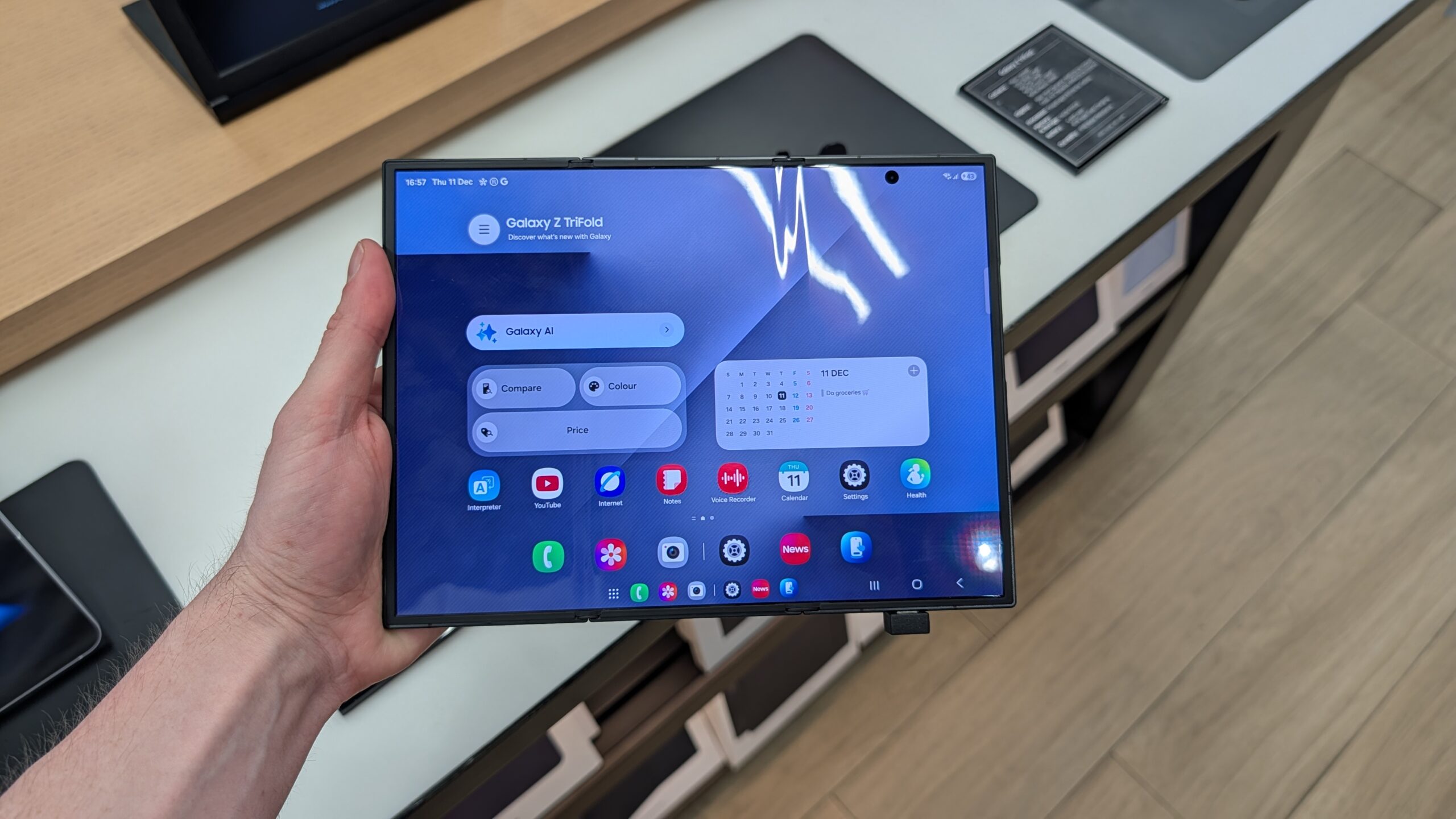
TL;DR
- Samsung’s Galaxy Z TriFold is apparently being sold at a loss, despite its ~$2,440 price tag in Korea.
- For what it’s worth, the TriFold is only being produced in small numbers and is only sold in a few markets.
- Samsung is reportedly struggling with Galaxy S26 series pricing as well.
The Samsung Galaxy Z TriFold is perhaps the most interesting Galaxy phone of the last few years, featuring a dual-folding design that differs from the trailblazing HUAWEI Mate XT. Samsung’s device isn’t cheap at ~$2,440 in Korea, but it sounds like the company might not be making a profit.
Korean news outlet The Bell reports that the Samsung Galaxy Z TriFold reportedly has a higher production cost than its selling price. In other words, Samsung’s newfangled device is apparently being sold at a loss.
It might seem impossible that a phone priced at $2,400 (or over $3,000 in some markets like the UAE) could lose money, but recent industry reports from late 2025 suggest the Galaxy Z TriFold is exactly that: a “loss-leader.“
While Samsung hasn’t publicly released its internal “Bill of Materials” (BOM), analysts and reports from Korean outlets like The Bell point to several reasons why the math doesn’t add up to a profit—at least not yet.
1. The Yield Rate Nightmare
The Z TriFold features two different hinges and a massive 10-inch OLED panel that has to fold in two different directions (an “S” curve).
-
Production Scrap: If a single pixel fails or the ultra-thin glass (UTG) cracks during the complex layering process, the entire $1,000+$ display assembly is scrapped.
-
Low Volume: Samsung is reportedly producing only 30,000 units globally for the initial run. Without “economies of scale” (building millions of units), the cost of setting up the specialized assembly line is spread over very few devices, making each one astronomically expensive to build.
2. Soaring Component Costs in 2025
The Z TriFold isn’t just a screen; it’s a spec powerhouse. In 2025, the cost of core components has spiked:
-
Memory (DRAM): High-speed RAM prices have surged due to the AI data center boom. The 16GB of RAM required to run Samsung’s “Galaxy AI” multitasking features on that huge screen is significantly more expensive than it was a year ago.
-
The Chipset: The Snapdragon 8 Elite is rumored to be one of Qualcomm’s most expensive chips ever, costing Samsung significantly more per unit than previous generations.
3. R&D Amortization
Samsung spent years developing the “Flex S” and “Flex G” dual-hinge technology. In a typical phone like the S25, those research costs are spread across 30 million units. For a niche experiment like the TriFold, the R&D “cost per phone” is likely thousands of dollars on its own.
4. The “Huawei” Factor (Strategic Pricing)
Samsung isn’t just competing with itself; it’s racing against the Huawei Mate XT.
The Strategy: Samsung likely lowered the price to $2,400 (it was initially rumored to be closer to $3,000) to remain competitive and ensure the device “sold out” to maintain its image as the leader in foldable tech. They are essentially paying for “marketing” by losing money on the hardware.
Comparison: Estimated Costs vs. Price
| Feature | Galaxy Z Fold 7 (Mass Market) | Galaxy Z TriFold (Experimental) |
| Retail Price | ~$1,899 | ~$2,400 |
| Estimated BOM | ~$1,100 | ~$2,500+ (including R&D) |
| Profit Margin | Healthy | Negative (Loss-Leader) |
| Target Audience | Enthusiasts | Collectors / Tech “Flex” |
Why do it?
Samsung is playing the “long game.” By getting the TriFold into the hands of 30,000 influencers and early adopters now, they can refine the manufacturing process. By the time they release a “Galaxy Z TriFold 2” or a “TriFold FE,” they hope to have the costs down enough to actually make a profit.