
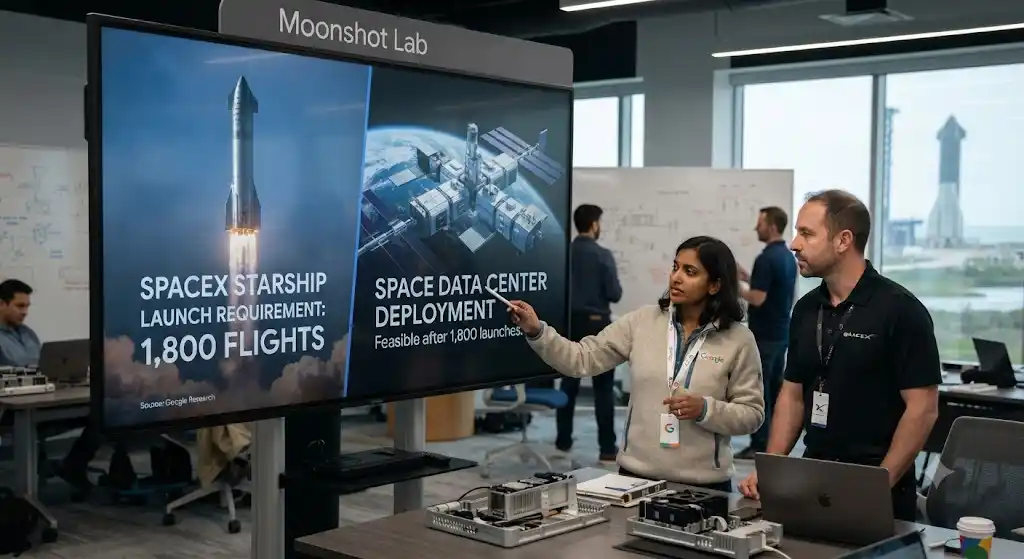
🚀🛰️ Google Thinks Space Data Centers Could Require 1,800 Starship Launches
Google is taking its idea of AI data centers in space seriously — but its own research shows just how massive the infrastructure challenge could be.
Google recently launched a prototype satellite carrying one of its Tensor Processing Units (TPUs) into orbit aboard a SpaceX rocket. The mission is designed to test whether advanced AI chips can operate reliably in space.
🌌 The bigger vision: Project Suncatcher
Google envisions eventually building orbital data centers using networks of satellites equipped with AI processors.
The concept could take advantage of abundant solar energy in orbit while reducing some of the land and power constraints faced by terrestrial data centers.
But getting enough hardware into orbit is the difficult part.
🚀 Google’s research estimates that Starship could need around 1,800 launches over 10 years to deliver roughly 370,000 tons of payload into orbit — assuming Starship eventually carries around 200 metric tons per launch.
That works out to roughly 180 launches per year.
⚠️ There’s a huge gap between that projection and today’s reality.
Starship has never flown more than five times in a single year, according to the report. Google’s analysis assumes launch costs continue falling dramatically as SpaceX improves Starship’s reusability and flight rate.
🧠 And the challenge isn’t only transportation.
Google also needs to prove that AI chips can survive radiation, manage heat, operate with limited power, and communicate efficiently between satellites.
The current prototype will run its TPU in short 15-minute bursts, while future demonstrations are expected to test multiple satellites communicating through laser links.
If successful, Google ultimately envisions an orbital network of 81 satellites working together as a large-scale computing cluster.
🚀 From rockets to satellites to AI chips, building a data center in space could require an entirely new infrastructure ecosystem.
The interesting part? The technology is being tested today — but the scale Google ultimately envisions is still years away.
#Google #SpaceX #Starship #AI #ArtificialIntelligence #SpaceTechnology #DataCenters #ProjectSuncatcher #CloudComputing #TechNews