
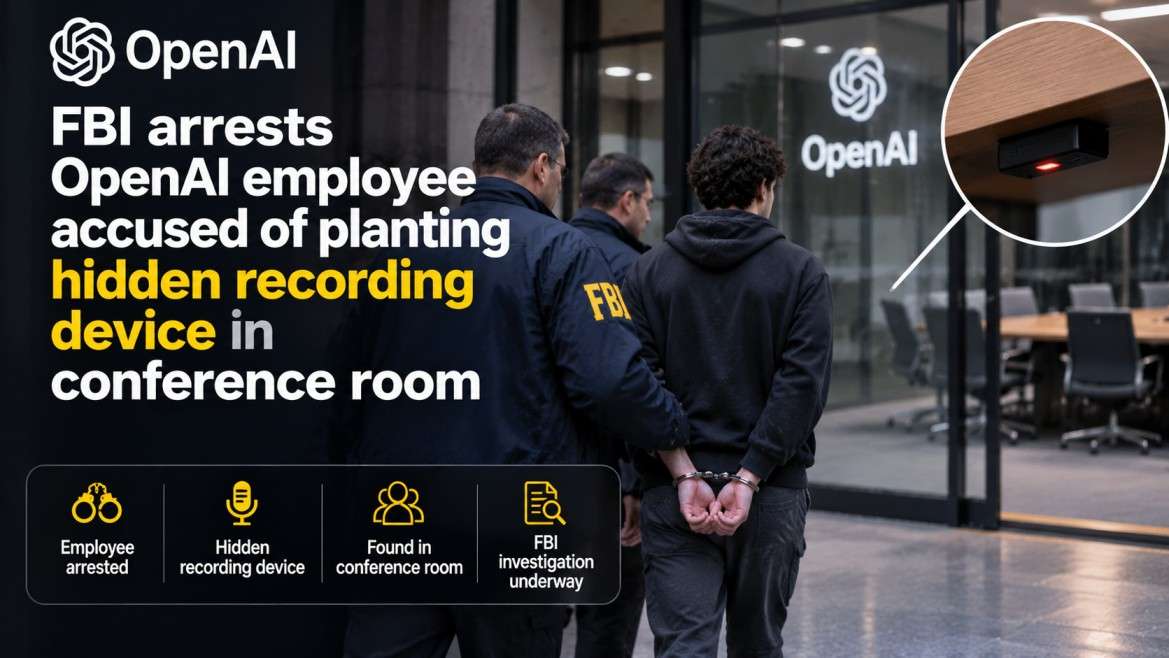
The Bug Behind the Screen: How an OpenAI Engineer Allegedly Wiretapped Executive Boardrooms
In Silicon Valley, high-stakes espionage usually conjures images of nation-state spear-phishing campaigns, compromised cloud infrastructure, or exfiltrated model weights moving via encrypted thumb drives.
At OpenAI’s San Francisco headquarters, the breach was far more old-school: a physical listening bug wrapped in tissue paper and plugged directly behind a conference room television.
Federal law enforcement stepped in to unseal charges against Abdulrahman Alfozan, an OpenAI engineer and Saudi national, accusing him of installing a surreptitious audio-recording device inside an executive conference room. The arrest—made just as the engineer reportedly booked a one-way international flight—shines a harsh light on the vulnerability of AI frontier labs to basic physical insider threats.
The Setup: Behind the Conference TV
According to federal court filings, the incident began unraveling in late September when OpenAI staff noticed something unusual behind a wall-mounted television inside a sensitive executive conference space:
* The Hardware: The device was plugged directly into an active USB port for continuous power. It was equipped with a high-sensitivity microphone, encrypted storage, and the hardware capacity to support live Wi-Fi streaming.
* The “Camouflage”: In an oddly low-tech attempt at physical concealment, the device had been wrapped in toilet paper and tucked behind the monitor bracket.
* The Chatbot Trail: In one of the most ironic twists of the investigation, federal agents traced queries on an AI chatbot account tied to Alfozan’s household. The prompts asked how to construct a continuous audio recorder, how to access it remotely over local Wi-Fi networks, and how to encrypt an SD card to prevent forensic extraction.
When internal security reviewed access logs and hallway camera feeds, they reportedly caught Alfozan ducking behind the screen to check on the device.
The Stakes: What Was Said in That Room?
While corporate boardrooms at any tech giant discuss sensitive roadmaps, an executive conference room at OpenAI houses conversations that border on national security:
* Frontier Model Architecture & Weights: Early deliberations on unreleased frontier models, internal safety evaluation results, and architectural breakthroughs worth billions in enterprise compute.
* Compute Strategy & Government Contracts: Discussions regarding hyperscaler infrastructure, defense partnerships, and deployment schedules under federal scrutiny.
* Strategic Commercial Moves: With OpenAI actively navigating restructuring into a fully commercial for-profit entity, executive spaces routinely handle non-public financial terms, investor alignments, and high-level leadership deliberations.
Federal prosecutors have not yet declared an official foreign intelligence tie, but the engineer’s quick attempt to secure a one-way ticket abroad triggered an immediate emergency takedown by the FBI before he could leave U.S. jurisdiction.
The Insider Threat Blind Spot in AI
The tech sector spends billions securing software perimeters, auditing API endpoints, and deploying zero-trust network architectures. Yet, as this case demonstrates, physical access remains the ultimate administrative bypass.
* Badge Access Overreach: When engineering personnel have unrestricted, unmonitored physical access to executive suites and boardrooms during off-hours, digital firewalls become irrelevant.
* The Corporate Paranoia Shift: AI labs are already operating under heightened counterintelligence alertness. With geopolitical competition between the U.S., China, and Middle Eastern sovereign funds pouring billions into compute clusters, labs like OpenAI, Anthropic, and Google DeepMind are prime targets for foreign intelligence collection.
* Physical Sweeps Return: Silicon Valley office managers historically treated conference rooms like open, collaborative hubs. In the wake of this breach, technical surveillance countermeasures (TSCM)—regular physical “bug sweeps”—are poised to become standard enterprise hygiene for frontier AI facilities.
The Takeaway
As artificial intelligence moves from an experimental software layer to the central strategic asset of global tech power, the nature of corporate risk fundamentally transforms.
- You can build the most secure encryption algorithms on earth and sandbox your models behind layers of enterprise authentication. But if an insider with a company badge can slip behind a conference TV and tape a powered microphone to the wall, all the digital security in the world won’t protect what gets said in the room.