
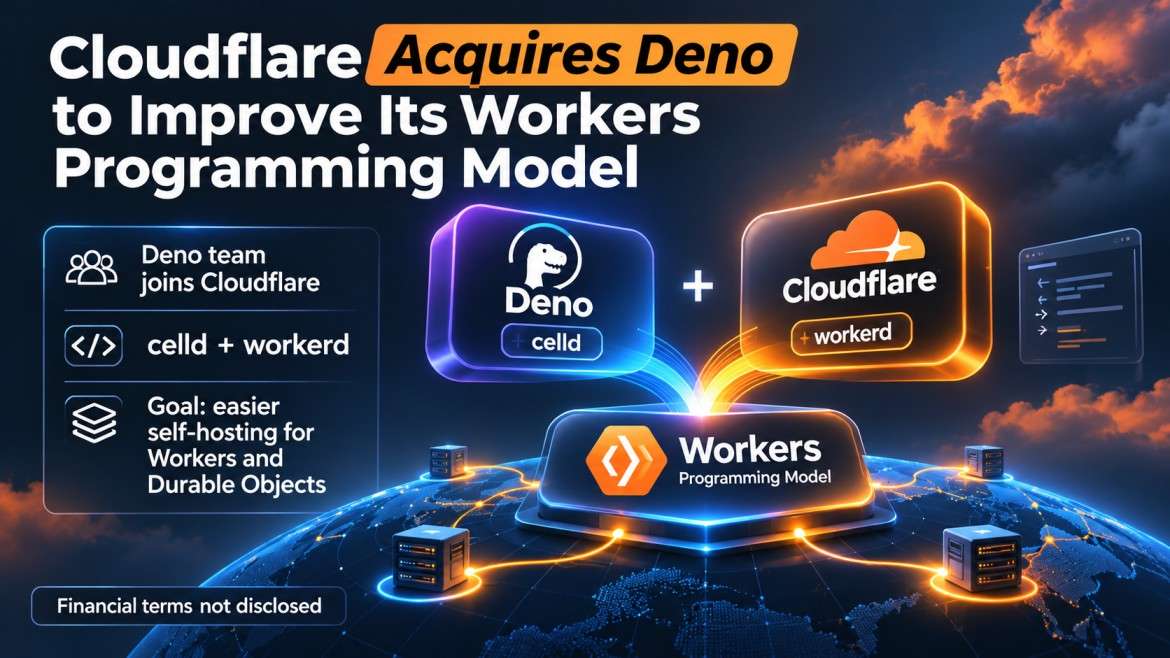
The End of the Runtime Wars: Why Cloudflare Bought Deno to Unlock Workers
In a massive consolidation for modern server-side JavaScript, Cloudflare has acquired Deno, bringing creator Ryan Dahl (who originally invented Node.js) and his entire engineering team in-house.
The deal marks a dramatic pivot: rather than continuing to compete as a standalone runtime rival to Node, Deno’s team will merge its work into Cloudflare to overhaul the Workers programming model and build a scalable, self-hostable open-source engine.
The Catalyst: Merging celld and workerd
The real driver behind the deal isn’t just acquiring talent—it’s an open-source project Deno released called celld.
* The Lock-In Criticism: Cloudflare’s edge runtime, workerd, has long been open source, but it had a glaring limitation: its support for Durable Objects (stateful, low-latency coordination primitives) was restricted to a single instance for local testing. Running distributed, stateful Workers on your own bare metal remained nearly impossible.
* Deno’s Breakthrough: Dahl built celld as an open-source implementation capable of running distributed Durable Objects and Workers across multiple servers backed simply by an object storage bucket.
* The Unified Vision: Cloudflare realized Deno had solved the exact distributed self-hosting ergonomics that workerd lacked. By merging the two projects, Cloudflare wants to make the Workers programming model an open industry standard that runs anywhere—not just inside Cloudflare’s proprietary edge.
What Happens to the Deno Ecosystem?
For developers currently building on Deno, the acquisition triggers a clear transition roadmap:
* The Deno Runtime: Cloudflare will maintain the open-source Deno runtime with security patches and bug fixes for one more year, after which official development will sunset (though the repo remains open for the community).
* Deno Deploy: The managed hosting platform will shut down in six months, with paying customers migrated over to Cloudflare Workers.
* JSR & Rust Crates: The JavaScript Registry (JSR) will remain active, with its backend infrastructure migrating onto Cloudflare. Supporting libraries like rusty_v8 will be integrated directly into workerd.
Why It Matters: Priming Workers for the AI Agent Era
Beyond standard web APIs, this acquisition is aimed directly at AI agents.
Autonomous agents require cheap, ephemeral execution loops paired with persistent state, real-time WebSockets, and rapid memory sync. Durable Objects provide that ideal harness.
By turning the Workers abstraction into a truly open, self-hostable runtime, Cloudflare removes the biggest objection holding enterprise teams back: fear of vendor lock-in.
The Takeaway
When Ryan Dahl launched Deno, he wanted to fix the design flaws of Node.js. But as Node’s ecosystem proved nearly impossible to displace, the battleground shifted from desktop runtimes to distributed cloud primitives.
By acquiring Deno, Cloudflare didn’t just eliminate an edge competitor—they gained the architect who invented modern server-side JavaScript to help them turn Cloudflare Workers into the default runtime for the next era of computing.