
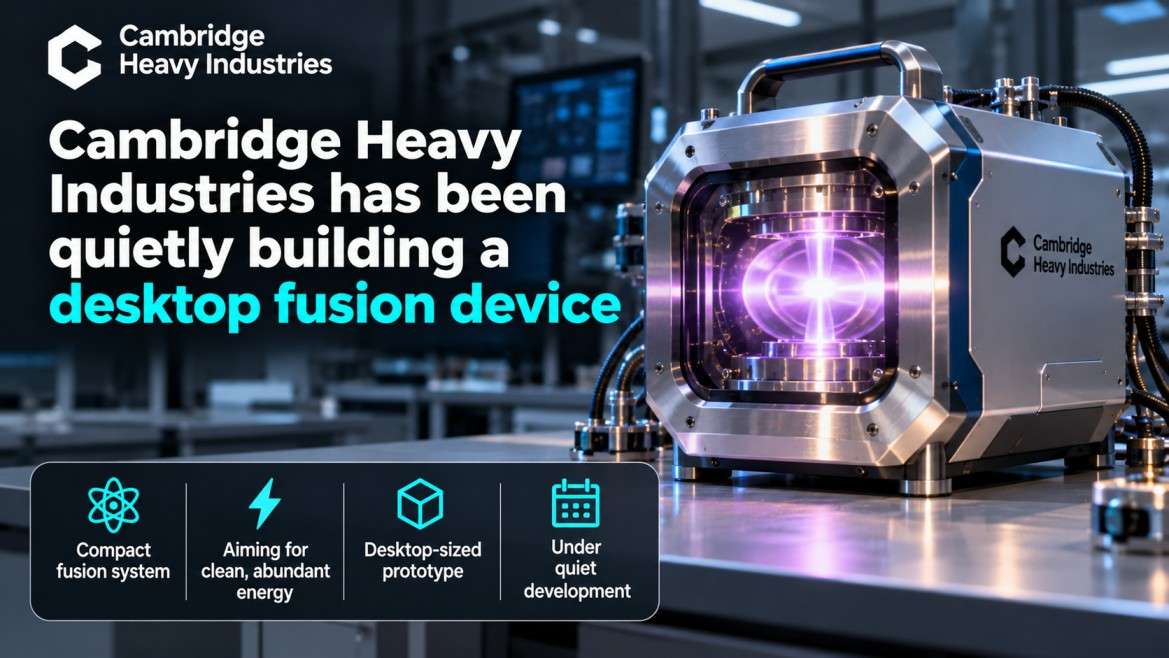
Shrinking the Star: Why Cambridge Heavy Industries Built a Desktop Fusion Device
Whenever nuclear fusion makes headlines, the imagery is almost always monumental. You picture the National Ignition Facility (NIF)—a football-stadium-sized facility firing 192 colossal lasers at a microscopic target—or the multi-billion-dollar steel donut of an ITER tokamak.
Commercial fusion has long been defined by extreme scale, astronomical capital expenditures, and multi-decade research timelines.
Operating quietly out of a lab linked to MIT, stealth startup Cambridge Heavy Industries is taking an entirely different approach. Armed with $6.2 million in seed funding, the company has been developing a benchtop, laser-driven fusion device roughly the size of two dinner tables.
Their goal isn’t to build a grid-scale power plant tomorrow. Instead, they are tackling the practical R&D and commercial bottlenecks holding the entire fusion industry back.
The Iteration Trap: Why Fusion Takes Decades
The central issue facing inertial confinement fusion (laser-driven fusion) has always been iteration speed:
* The Giant Laser Problem: Firing dozens or hundreds of synchronized, high-energy laser beams requires days of cooling, realigning optics, and replacing damaged hardware. Large-scale facilities often run only a handful of experimental shots per week.
* Capital Intensity: Testing a new plasma hypothesis or fuel capsule geometry can cost hundreds of thousands of dollars per experiment.
* Slow Feedback Loops: When an experiment takes months to prepare and execute, training modern machine learning models to optimize plasma dynamics becomes agonizingly slow.
Cambridge Heavy Industries realized that the fastest way to accelerate fusion energy isn’t building bigger lasers—it’s drastically compressing the feedback loop.
The Shockwave Breakthrough: Extreme Pressure on a Budget
Instead of blasting targets with brute-force laser arrays, Cambridge Heavy Industries relies on an innovation in shockwave science and target physics spun out of MIT’s Nelson Lab.
* Concentric Geometry: The device uses just two opposing, synchronized lasers to deliver concentric shockwaves into a tiny fuel capsule.
* 400x Higher Compression Efficiency: By precisely shaping the shockwaves, the prototype achieves compression efficiencies reported to be 400 times higher than conventional laser fusion approaches, using only fractions of the input energy.
* Center-of-the-Earth Pressures: The team’s table-sized prototype has already generated pressures exceeding 350 gigapascals (GPa)—comparable to conditions at the Earth’s core—using tens of millijoules of energy.
* 50 to 80 Shots a Day: Because the setup uses compact, off-the-shelf equipment and modest laser energy, it doesn’t melt down or require hours of cooling. The team can run 50 to 80 fusion experiments per day, generating dense datasets to rapidly fine-tune plasma models and target designs.
The Intermediate Cash Cow: Producing Tritium
One of the smartest elements of Cambridge Heavy Industries’ playbook is its commercial strategy.
Most fusion startups promise a commercial net-energy power plant twenty years in the future, running entirely on venture capital subsidies until then. Cambridge Heavy is targeting near-term intermediate revenue by selling the byproducts of fusion reactions: tritium and neutron beams.
* The Tritium Cliff: Deuterium-tritium (D-T) is the fuel mix of choice for the majority of commercial fusion reactors under development. The problem? Tritium is an extremely rare, radioactive isotope with a 12.3-year half-life. Global stockpiles—largely produced by aging Canadian CANDU fission reactors—are dwindling fast.
* Fueling the Competitors: By configuring its compact fusion cells to harvest neutrons and breed tritium, Cambridge Heavy can become a picks-and-shovels supplier, selling the indispensable fuel needed to test other startups’ larger reactors.
* Neutron Imaging & Materials Testing: The device’s high-frequency neutron output can also be sold for semiconductor defect inspection, non-destructive aerospace imaging, and advanced materials stress testing.
The Takeaway
Silicon Valley learned long ago that rapid software iteration beats slow, monolithic development. In deep tech, hardware that can iterate dozens of times a day will always out-learn hardware that iterates once a month.
Cambridge Heavy Industries isn’t trying to power a city grid from a desktop. They are building the high-frequency testbed—and the critical fuel supply chain—that the rest of the fusion ecosystem desperately needs.
- By turning fusion from a rare, monumental spectacle into a repeatable daily lab experiment, the startup proves that the road to unlimited clean energy might actually start on a benchtop.