
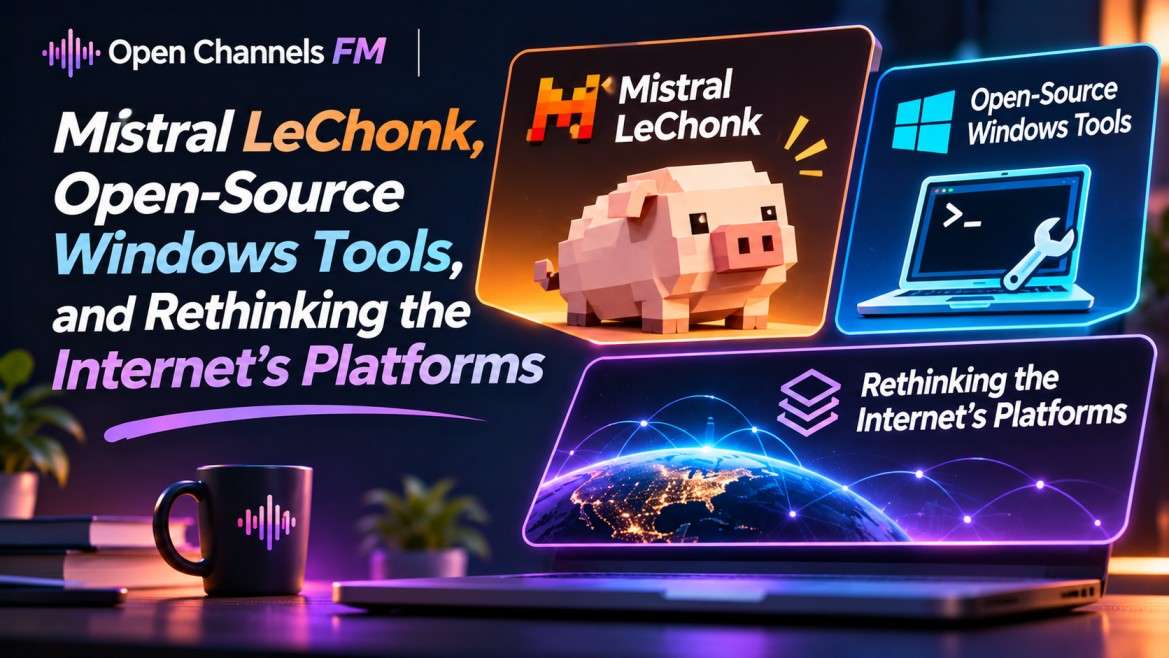
Taking Back Control: Mistral LeChonk, Open Windows Tools, and Platform Fatigue
Who actually controls the software stack you rely on every day: you, or the platform hosting it?
In a recent episode of Open Channels News, host Robert Jacobi connected the dots across three seemingly unrelated corners of tech—frontier AI model weights, desktop OS customization, and web platform fatigue. The unifying theme across all three: the growing push for user agency, sovereignty, and the freedom to walk away from proprietary lock-in.
Here is what was covered and why it matters.
1. Mistral’s “LeChonk”: Trillion-Parameter AI on Your Own Terms
France’s Mistral AI previewed Mistral Large 4, informally dubbed LeChonk—a massive one-trillion-parameter open-weight model designed for enterprise workloads.
-
The Core Problem: Companies building mission-critical workflows on closed API endpoints (OpenAI, Anthropic, Google) are permanently vulnerable to sudden pricing changes, model deprecations, and service outages they cannot control.
-
The Open-Weight Pitch: While LeChonk isn’t strictly pure open-source, providing open weights allows enterprises to self-host and customize the model on their own infrastructure. It shifts the AI purchasing debate from pure leaderboard benchmarks to questions of data sovereignty, infrastructure portability, and vendor autonomy.
-
The Reality Check: Running a trillion parameters isn’t cheap. Compute and maintenance overhead mean only well-resourced organizations can take advantage of self-hosting at that scale.
2. Open-Source Tools Reclaim the Windows Desktop
For power users exhausted by telemetry, uninvited web widgets, and locked taskbar designs in modern Windows, open-source developers are stepping in to restore sanity.
-
The Projects: Community utilities like Windhawk, ExplorerPatcher, NileSoft Shell, and Celine UI are giving users granular control over context menus, navigation, and system UI.
-
The Philosophy: An operating system should adapt to the person sitting at the keyboard, not dictate the experience to serve platform engagement.
-
The Trade-Off: Deep OS tweaking comes with maintenance responsibility. Third-party UI injectors can break when Microsoft pushes monthly cumulative updates, requiring careful patch management.
3. Rethinking the Internet: Reclaiming the Web from Big Platforms
Drawing on provocative essays from Wired and tech analyst Ben Thompson, the episode examined the systemic exhaustion with algorithmic feeds and floodgates of synthetic AI slop.
-
Platform Decay: Centralized social giants and ad-driven networks are increasingly optimized for outrage loops and programmatic content rather than genuine human connection.
-
The Migration to Independence: The open web was engineered for decentralized publishing, personal blogs, and independent communities—not rent-seeking gatekeepers. More creators and users are shifting attention toward federated platforms, RSS feeds, and small-scale community spaces.
The Takeaway
Open-source and open-weight software isn’t always simpler, cheaper, or completely bug-free. What it delivers that closed ecosystems never can is exit power.
Whether you are deciding where to host a trillion-parameter AI model or simply fixing the right-click menu on your PC, the principle remains identical: real software control means having the ability to inspect the code, adapt it to your needs, and leave when the terms change.