
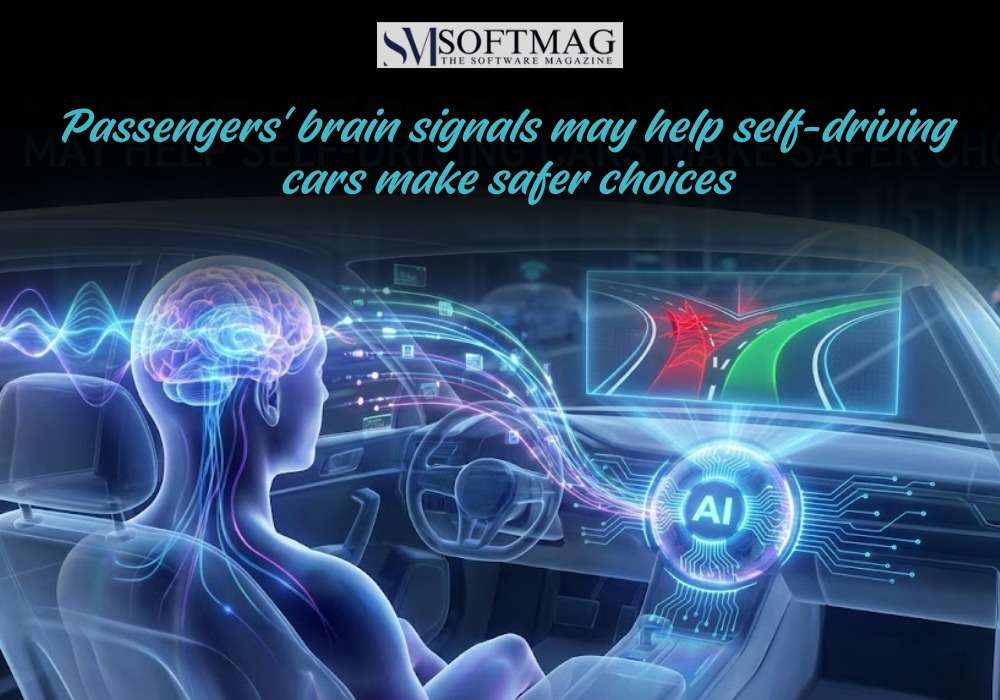
Cars from companies like Tesla already promise hands-free driving, but recent crashes show that today’s self-driving systems can still struggle in risky, fast-changing situations.
In a breakthrough reported in late December 2025, researchers have demonstrated that integrating passengers’ brain signals directly into autonomous driving systems can significantly improve safety and comfort.
According to a study published in the journal Cyborg and Bionic Systems (December 30, 2025), a team led by Professor Xiaofei Zhang at Tsinghua University has developed an AI framework that “listens” to the human brain to refine how a self-driving car reacts to danger.
The Tech: fNIRS and “Risk Perception”
Unlike previous systems that relied on exterior cameras alone, this new approach uses functional Near-Infrared Spectroscopy (fNIRS). This non-invasive technology monitors blood flow in the prefrontal cortex—the area of the brain responsible for complex decision-making and emotional response.
-
Detecting Intuition: Human passengers often sense a “bad vibe” or a risky situation (like a car swerving nearby) milliseconds before a machine might categorize it as a formal threat.
-
Real-Time Stress Mapping: The fNIRS sensors detect when a passenger’s stress or “risk perception” levels spike, even if the passenger remains physically still.
How the Car Adjusts
The system uses a Deep Reinforcement Learning algorithm to fuse this neural data with the car’s sensor suite. When the brain signals indicate the passenger is nervous:
-
Model Switching: The car instantly switches from a “standard” driving mode to a Conservative Intelligent Driving Model (IDM).
-
Safety Actions: The vehicle increases following distances, reduces speed, and initiates smoother braking patterns.
-
Faster Learning: Researchers found that by using human brain signals as a “guide,” the AI learned to navigate complex, risky scenarios much faster than by using traditional machine-learning trial and error.
Why This Matters for 2026
| Problem | Brain-Signal Solution |
| The “Trust Gap” | Many people fear AVs because they feel out of control. A car that “feels” your discomfort and slows down builds immediate psychological trust. |
| Complex Edge Cases | AI often struggles with “social” driving cues. Human brains are highly evolved to detect intent in other drivers, which the AI can now harvest. |
| Comfort vs. Safety | Traditional AVs can be “jerky” when they detect obstacles. Neural feedback helps the car find the sweet spot between safe stopping and passenger comfort. |
The Roadmap to Your Dashboard
While the 2025 study is a major academic milestone, you won’t see “brain-reading caps” in your Uber just yet.
-
Current Stage: Prototype testing in simplified driving environments.
-
Next Steps (2026-2027): Validation in complex urban traffic and the development of “invisible” sensors embedded in car headrests, removing the need for passengers to wear specialized headgear.