
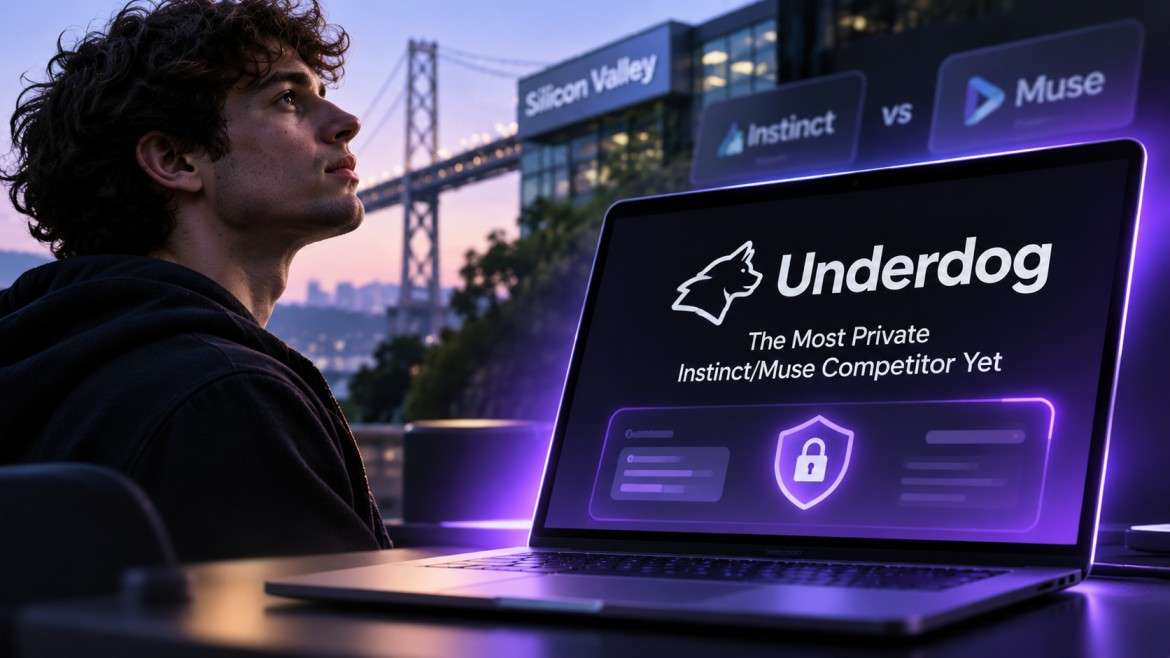
Privacy by Architecture: Sigil Wen’s Underdog Takes on Big Tech’s AI Assistants
As digital assistants like Meta’s Muse and Google’s Instinct race to integrate deeper into our digital lives, they carry an uncomfortable compromise: streaming your personal context, keystrokes, and queries directly to centralized cloud servers.
Now, Silicon Valley developer Sigil Wen—backed by heavyweight angels including Stripe co-founder Patrick Collison—is launching Underdog, an AI assistant designed to prove that ambient intelligence doesn’t require surrendering your privacy.
The Tech: Fully On-Device Inference
Rather than renting hyperscaler GPU farms, Underdog offloads the entire computational footprint onto the hardware you already own:
* The Local Model: Runs a 27-billion-parameter reasoning model fine-tuned on top of open-weight foundations, designed to handle daily desktop tasks, research, and coding.
* The Husky Engine: Powered by Wen’s custom-built inference engine, Husky, which dramatically cuts data transfer bottlenecks between the main CPU and local GPU/NPU cores.
* Zero Cloud Bleed: Available in beta for macOS and Windows (with mobile in the pipeline), Underdog processes inputs locally—meaning no transcripts or context logs leave your machine.
A Radical Business Model: No Subs, No Ads
Cloud-hosted AI assistants face staggering inference bills, forcing platforms to either charge monthly tolls (ChatGPT Plus) or harvest user intent for targeted ads (Meta’s Muse). Because Underdog’s marginal inference cost is practically zero, it bypasses both:
* Free to Use: No recurring subscription fee or tiered paywalls.
* Never Ad-Supported: Avoids building user profiles or selling ad slots against conversations.
* The Interchange Play: Monetization occurs solely through agentic transactions. When the assistant autonomously buys items or books services on your behalf via Stripe’s infrastructure, Underdog clips a small fee—aligning incentives around task completion rather than engagement farming.
The Takeaway
The AI race has largely operated on the assumption that only massive, cloud-scale clusters can power capable personal assistants. Underdog challenges that premise head-on. By marrying aggressive local model optimization with an interchange-based business model, Wen isn’t just offering a private alternative to Muse or Instinct—he’s proposing a future where your personal assistant answers strictly to your hardware, not someone else’s data center.