
The Phone Call Is Dead: Yelp’s New AI Agent Will Call the Restaurant for You
For years, dinner planning has run into the same awkward social friction: you want to know if a popular spot has a table open right now, but nobody at the table actually wants to dial the restaurant and talk to a human host.
Yelp is officially stepping into the phone booth.
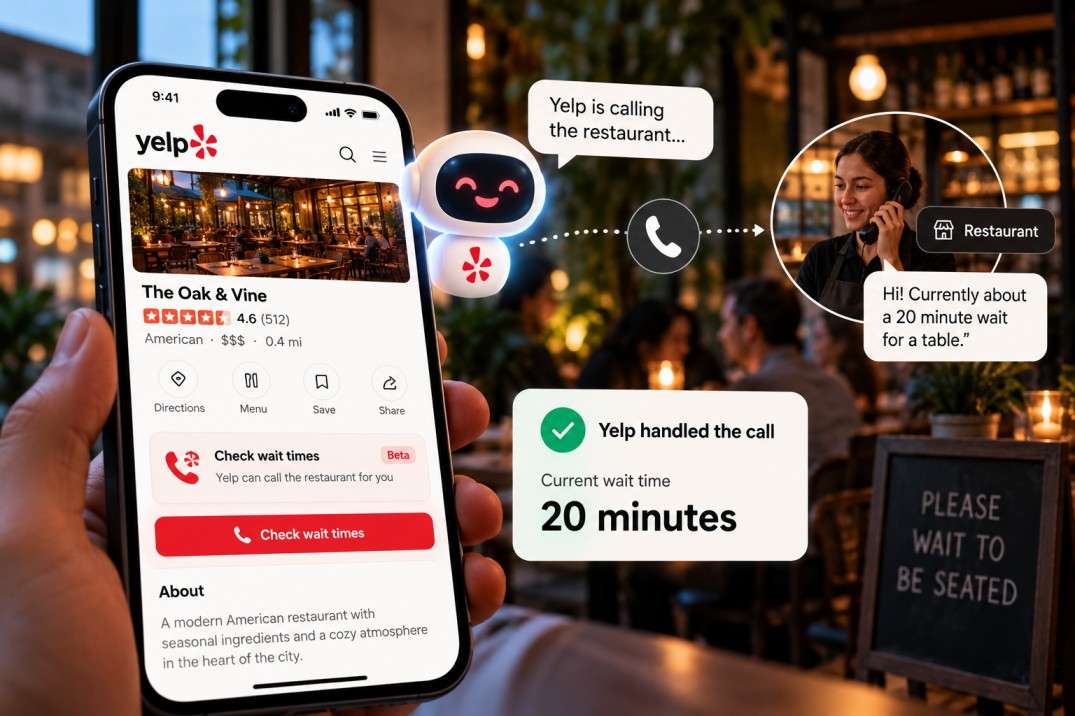
As part of its major product release, Yelp introduced “Check for Me,” an autonomous AI voice agent that calls restaurants on your behalf, speaks directly to the host stand to find out current wait times, and texts the result straight back to your phone in minutes.
It’s an undeniable win for phone-averse diners—and the clearest sign yet that the consumer internet is pivoting from search engines to autonomous delegation.
How “Check for Me” Actually Works
Instead of digging up a phone number and enduring hold music over a bustling kitchen background, the workflow inside the Yelp app is reduced to a couple of taps:
* You tap “Check wait time now” on an eligible restaurant’s Yelp page or inside Yelp Assistant.
* You input your party size and confirm your phone number.
* The AI agent places an automated voice call to the host stand, holds a natural conversational exchange, asks for the current wait for that specific party size, and hangs up.
* Within minutes, you receive an SMS update with the wait time so you can decide whether to head over or pick another spot.
The rollout begins on iOS in the U.S. across eligible restaurants, pairing with expanded OpenTable reservation integrations built directly into Yelp’s core chat interface.
The Shift from Information to Action
Search tools used to be passive directories: they gave you an address, operating hours, and a telephone number, leaving the execution up to you.
When Google unveiled Duplex back in 2018, it offered an early, mind-bending proof of concept for AI placing real-world phone calls. But outside of niche reservation tests and holiday hours checks, voice agents rarely became an everyday utility for casual weekend dinners.
Yelp’s deployment is different because it targets the most frequent, unresolved question in local dining: real-time capacity.
Most neighborhood spots, lively brewpubs, and walk-in-only pizza joints don’t run digital reservation books. Their live capacity exists purely in the memory of the host working the door. By giving conversational AI a dialer, Yelp is bridging the gap between analog reality and digital convenience without forcing mom-and-pop restaurants to overhaul their hardware.
The Host Stand Dilemma: Bot Meets Worker
While diners will celebrate never having to dial a restaurant again, the dynamic behind the host stand is bound to get interesting.
Front-of-house staff are already juggling ringing phones, guests walking through the door, and table turnarounds on busy Friday nights. If dozens of potential patrons unleash AI bots to poll wait times simultaneously, will restaurant workers feel bombarded by synthetic callers?
Even wilder: as restaurants adopt their own AI receptionists to field incoming queries, we are rapidly heading toward an internet where your AI agent calls the restaurant’s AI agent, leaving both humans completely out of the conversation.
The Takeaway
The era of software acting purely as an informational lookup is fading. The next wave of consumer tech is entirely about agency—delegating mundane, everyday friction to models that can take real-world action on your behalf.
Calling ahead to check on a table for four was always a chore. Now, you can let an algorithm take the social awkwardness off your hands.