
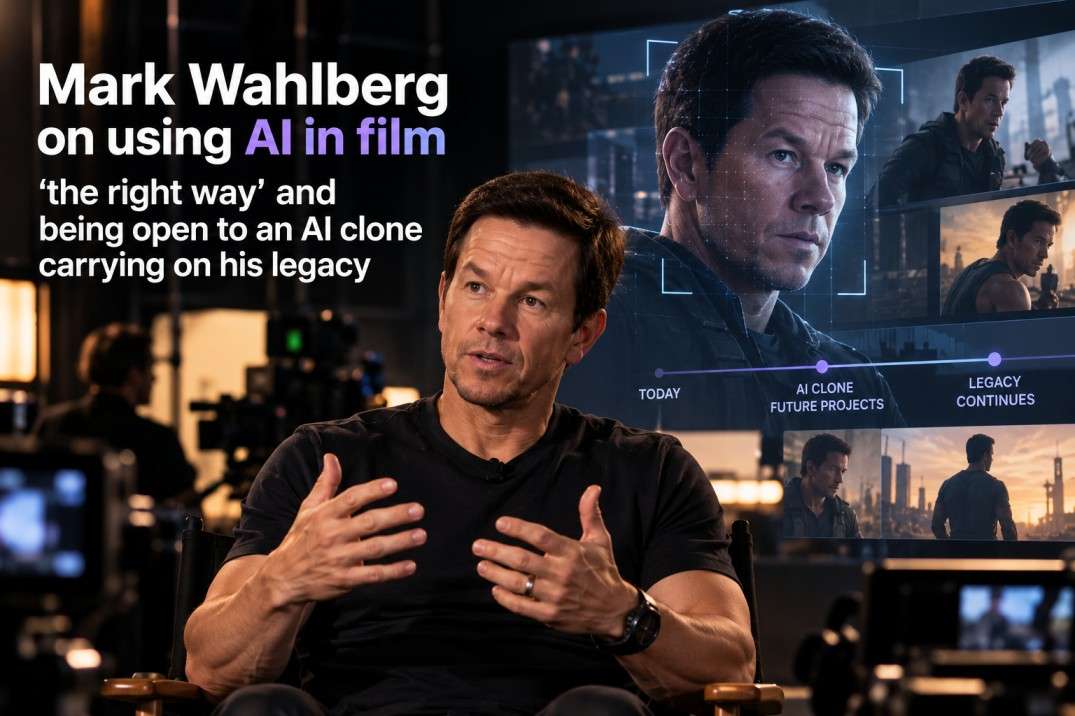
Beyond the Grave: Why Mark Wahlberg Is Open to an AI Clone Carrying His Hollywood Legacy
Ever since generative AI landed in Hollywood, the actor community’s response has largely been defensive: strike lines on picket routes, fierce contractual battles over likeness rights, and existential dread over synthetic deepfakes replacing human talent.
Then Mark Wahlberg walked onto the TechCrunch Disrupt stage in San Francisco and offered a surprisingly pragmatic take.
Rather than treating artificial intelligence purely as an artistic threat, the actor, producer, and entrepreneur laid out his philosophy on using AI in filmmaking “the right way”—and revealed that he is completely open to an AI digital replica continuing his acting career long after he’s gone.
“Enhance, Don’t Displace”
Wahlberg’s endorsement of AI isn’t a carte-blanche hall pass for studio cost-cutting. He drew a sharp boundary between technological assistance and creative bankruptcy:
* No Automated Shortcuts: Wahlberg explicitly pushed back against the idea of typing a prompt into an LLM, generating a synthetic script, and churning out a film with digital puppets. Real storytelling, emotional truth, and human nuance remain non-negotiable.
* Enhancing the Production Pipe: Where he welcomes the tech is in heavy lifting and visual enhancement—streamlining post-production workflows, de-aging, digital cleanup, and practical visual effects that allow ambitious stories to get made without multi-hundred-million-dollar bloat.
To Wahlberg, AI should function like high-end computer-generated imagery did decades ago: an invisible toolkit designed to serve the narrative, not displace the humans telling it.
The Digital Estate: Letting His Kids Hold the Keys
The most eye-opening part of Wahlberg’s comments wasn’t about production tools; it was about post-mortem likeness.
When asked about the possibility of an AI clone carrying on his career in future projects or extending franchises like Ted, Wahlberg didn’t flinch. “I wouldn’t be opposed to it,” he remarked, noting that if audiences have a genuine appetite to see those stories continue, they should have the opportunity.
Crucially, his openness comes with one vital condition: generational control.
Wahlberg wants any future deployment of his digital likeness governed directly by his children and grandchildren. Instead of signing away perpetual digital rights to a Hollywood studio or private equity holding firm, his model treats a digital persona as intellectual property held in a family trust.
If future generations of his family decide a script meets his creative standards and honors his catalog, they can greenlight the project and retain the economic upside.
The Shifting Frontier of Likeness Rights
Wahlberg’s stance reflects how the conversation around Hollywood digital doubles is maturing:
* From Fear to Monetization: The early panic was focused on studios secretly scanning background actors to reuse them for free. Now, marquee A-listers are recognizing that their brand, voice, and face are durable assets that can be legally structured and licensed on their own terms.
* Audience-Driven Demand: As Wahlberg pointed out, synthetic performances won’t succeed purely because studios mandate them. If an audience feels a digital clone lacks soul, the box office will punish it. But if the storytelling holds up, viewers have historically embraced technological evolution.
The Takeaway
Hollywood spent the last two years debating whether AI will destroy filmmaking. Mark Wahlberg’s perspective suggests a different endgame: the technology will inevitably exist, so you might as well control the terms.
By setting clear boundaries on creative integrity while treating his digital persona as a protectable family estate, Wahlberg is pointing to an era where an actor’s filmography no longer ends with their final breath—provided their family holds the prompt.