
The End of the Retooling Tax: Why Industrial Next Wants Factory Robots to Adapt in Minutes, Not Weeks
Walk onto any advanced factory floor, and you will see an army of industrial robotic arms moving with dizzying precision. They weld seams, stamp sheet metal, and torque bolts with superhuman repeatability.
There’s just one catch: they are brilliant at exactly one thing.
If an engineering team tweaks a smartphone chassis by two millimeters or alters the routing of a fragile ribbon cable, the entire line halts. What follows is an agonizing, expensive ritual: specialized systems integrators spend weeks rewriting rigid, line-by-line automation code, recalibrating machine vision, and machining custom physical jigs.
Industrial Next, a San Francisco startup founded by former Tesla autonomous-manufacturing leads and a standout finalist in the Startup Battlefield at TechCrunch Disrupt, is setting out to eliminate that retooling tax forever.
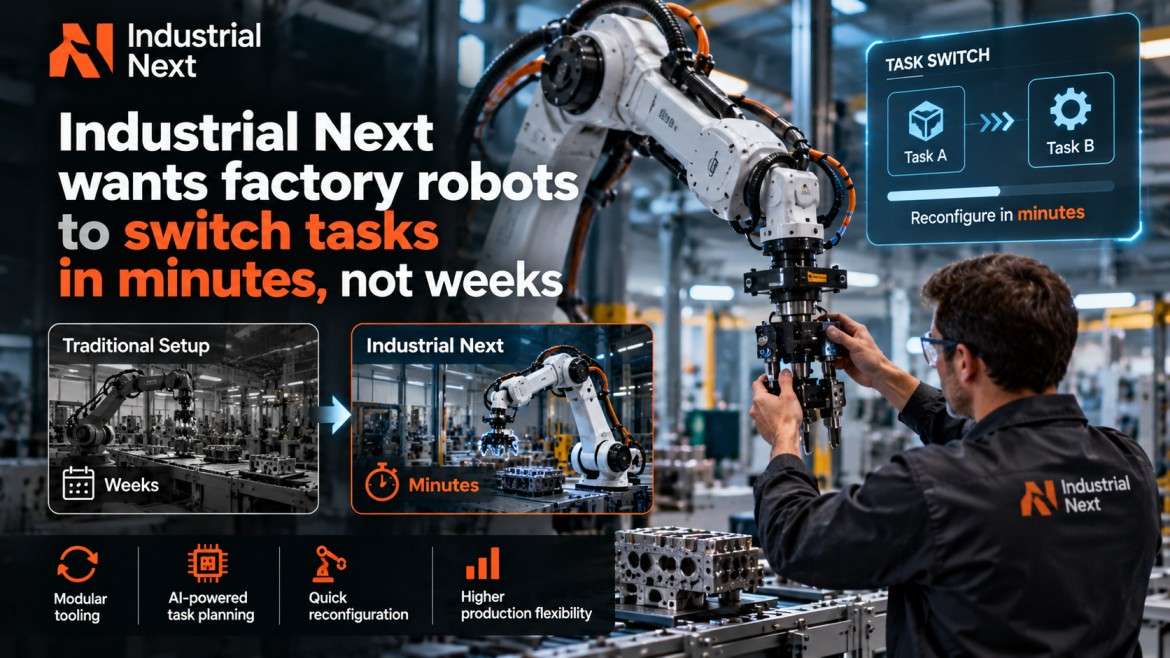
Their pitch is blunt: teach factory robots the way you teach a human worker—by demonstration and context—and switch production tasks in minutes, not weeks.
The Tesla Paradox: Why Automation Broke
Industrial Next co-founders Allen Pan and Lukas Pankau spent years inside Tesla’s Fremont factory leading autonomous manufacturing initiatives. While there, they ran into a bizarre technological contradiction that plagues modern hardware engineering:
> “We had all these fancy things that we could do on cars. I could run machine learning algorithms to design a car for me. But I couldn’t figure out how to program a robot, and this was pretty common for engineers at Tesla,” Pankau recalled. “You had this massive divide.”
>
Automakers and electronics manufacturers could design cutting-edge products using generative AI and parametric software in hours. Yet, the physical machines responsible for assembling those designs remained trapped in the 1980s—reliant on brittle, hand-scripted coordinate routines that break the moment reality varies by a fraction of a millimeter.
The result? The most delicate, high-dexterity assembly jobs—like threading flexible connectors, inspecting subtle cosmetic flaws, or inserting tiny screws—are still done almost entirely by human hands.
The New Architecture: AI-Defined Work Cells
Instead of writing custom scripts for every single part, Industrial Next replaces the traditional robotic setup with AI-defined, modular work cells.
The platform bridges the gap between seeing and doing through three core innovations:
* Foundational Multimodal Physical Models: Rather than separating computer vision from motion planning, Industrial Next trains models that connect visual perception, spatial context, and actuation simultaneously. The camera and the robot operate as a single nervous system.
* Learning by Demonstration: To teach a robot a new task, an operator demonstrates the movement. The system observes the human demonstration, generalizes the objective through simulation, and translates it into robotic trajectories in days instead of months.
* Adaptive Tolerance: If a component arrives slightly tilted, bent, or off-center on the conveyor, the robot doesn’t throw an error code and trip an emergency stop. It dynamically adjusts its grip and entry angle in real time, mimicking human hand-eye coordination.
When a new product variant enters the production line, operators don’t wait for outside automation consultants. They load the new task parameters, and the cell reconfigures within minutes.
Why Agility Is a Matter of Survival
The demand for hyper-flexible manufacturing isn’t theoretical—it’s driven by the shifting economics of global supply chains.
* Shorter Product Cycles: Consumer electronics, medical devices, and automotive components iterate faster than ever. If a production run only lasts six to nine months, spending two months programming the assembly line eats up a massive chunk of profitability.
* Contract Manufacturing Realities: Electronics manufacturing services (EMS) run on thin margins and handle dozens of client SKUs. A line that sits idle waiting for retooling burns cash; a line that can swap from assembling one tier-one smartphone component to another in under an hour becomes a massive competitive moat.
* Reshoring Demands: As Western nations push to rebuild domestic industrial capacity amid geopolitical tensions, they face severe skilled labor shortages. Without robots that can handle high-mix, low-volume assembly, reshoring complex electronics simply isn’t economically viable.
Industrial Next’s systems are already proving their mettle in live environments, delivering sub-3.5-second cycle times and over 99.9% accuracy on commercial lines.
The Takeaway
For decades, industrial robotics operated on an unbending trade-off: you could have high speed and precision, or you could have flexibility—never both.
Industrial Next represents the physical manifestation of the AI revolution. By swapping brittle scripting for adaptive, foundation-model-driven physical intelligence, they are turning factory robots from rigid, single-purpose appliances into adaptable, software-defined tools.
The future of manufacturing won’t belong to the factories with the heaviest machinery, but to the ones that can change their minds the fastest.