
The Microphone Mismatch: Why Flock Safety’s Audio Claims Don’t Match Its Own Specs
When a surveillance company installs a physical microphone on a public utility pole outside your house, the precise scope of what that device listens for ceases to be a marketing detail—it becomes a civil liberties question.
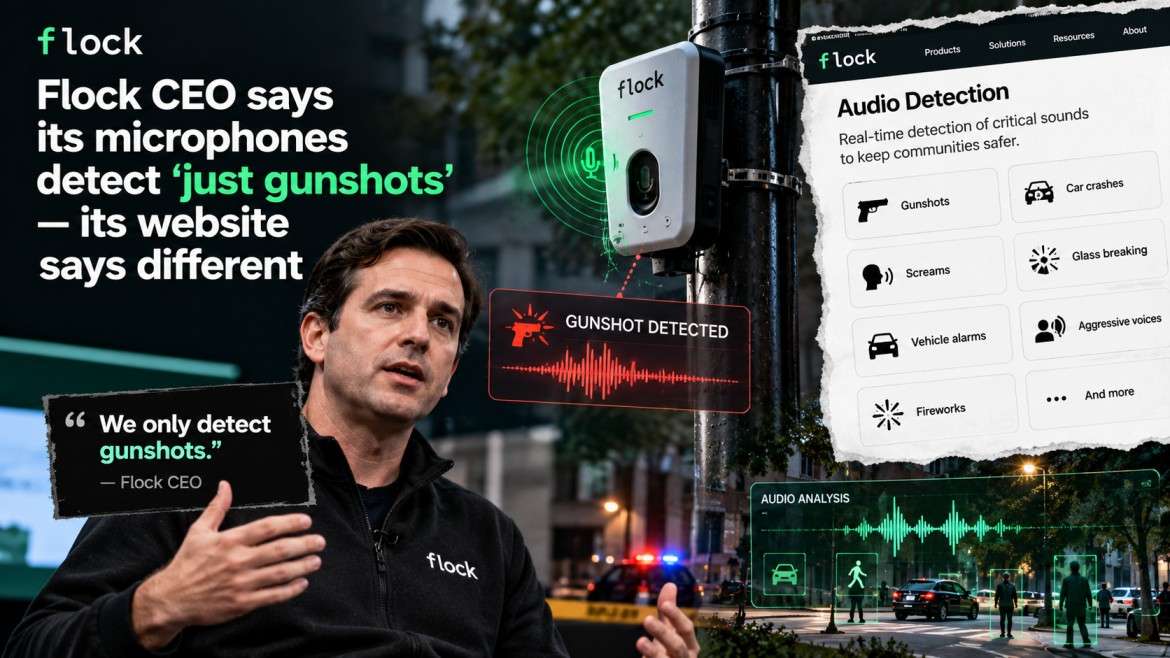
Speaking on stage at TechCrunch Disrupt in San Francisco, Flock Safety CEO Garrett Langley attempted to downplay mounting concerns around the company’s acoustic listening hardware. His claim was unequivocal: the company’s microphones detect “just gunshots.”
There was only one problem: Flock’s own marketing collateral, technical documentation, and official corporate spokespeople say otherwise.
What Langley Said vs. What the Hardware Does
The discrepancy surfaced almost immediately after Langley stepped off stage:
* The Stage Claim: Langley told the Disrupt audience that Flock’s audio sensors are strictly configured for gunfire detection, framing the technology as a narrow, emergency-response tool.
* The Product Reality: Flock’s official website and product documentation for its acoustic system (formerly known as Raven, now marketed as Flock Audio Detection) explicitly list a much wider sound-recognition taxonomy. Beyond gunshots, the system is designed to identify and trigger alerts for fireworks, sideshows (street takeovers), and potential motor vehicle crashes.
* The Corporate Walk-Back: When pressed on the contradiction, a Flock spokesperson confirmed to reporters that the acoustic hardware is indeed capable of detecting multiple sound categories—clarifying that Langley intended to emphasize that the devices do not transcribe spoken conversations or process conversational speech.
The Shadow of “Human Distress”
This isn’t the first time Flock’s audio narrative has collided with public scrutiny.
The company previously marketed a capability to detect “screaming”—later softened to “sounds of human distress”—which was pitched as a way to alert first responders to assaults or violent altercations. That feature triggered immediate alarm from organizations like the Electronic Frontier Foundation (EFF) and the ACLU.
Civil liberties advocates pointed out that training street-corner microphones to flag “human distress” inevitably requires algorithmic processing of human vocalizations in open public space—creating an unavoidable chilling effect on free speech and assembling.
Flock eventually paused and rolled back that feature after small pilot trials, with Langley admitting on stage that testing distress detection had been a “mistake”. Yet the fact that the underlying hardware was capable of running such models in the first place illustrates why critics view surveillance hardware with persistent skepticism: microphones on poles don’t change, but the firmware running on them can change overnight.
The Mission-Creep Dilemma
The tension over Flock’s audio detection reflects the classic playbook of surveillance mission creep:
* The Wedge Pitch: Infrastructure is sold to a skeptical city council or HOA on a narrow, high-urgency justification (e.g., catching stolen cars or dispatching police to active gunfire).
* The Sensor Density: Once tens of thousands of solar-powered nodes, cameras, and microphones are mounted across neighborhoods, the physical infrastructure is established.
* The Software Expansion: Software updates gradually expand detection libraries to monitor traffic violations, car meets, loud vehicles, and crowd sounds—broadening the net far beyond the original pitch.
When an executive brushes off acoustic hardware as “just gunshots,” it obscures the reality of what algorithmic audio sensors actually do: continuously sample the ambient soundscape of a neighborhood to classify acoustic events against proprietary machine-learning models.
The Takeaway
The debate surrounding automated policing tech is no longer just about whether an algorithm can catch a suspect. It is about transparency and consent.
Saying your sensors listen for “just gunshots” when product sheets advertise detection for car crashes, sideshows, and fireworks undermines the already fragile trust between surveillance vendors and the communities living under their lenses. As cities increasingly scrutinize private surveillance contracts, tech leaders can’t afford to tell one story to a tech conference audience and another to their municipal sales leads. When it comes to microphones on neighborhood streets, every word matters.