
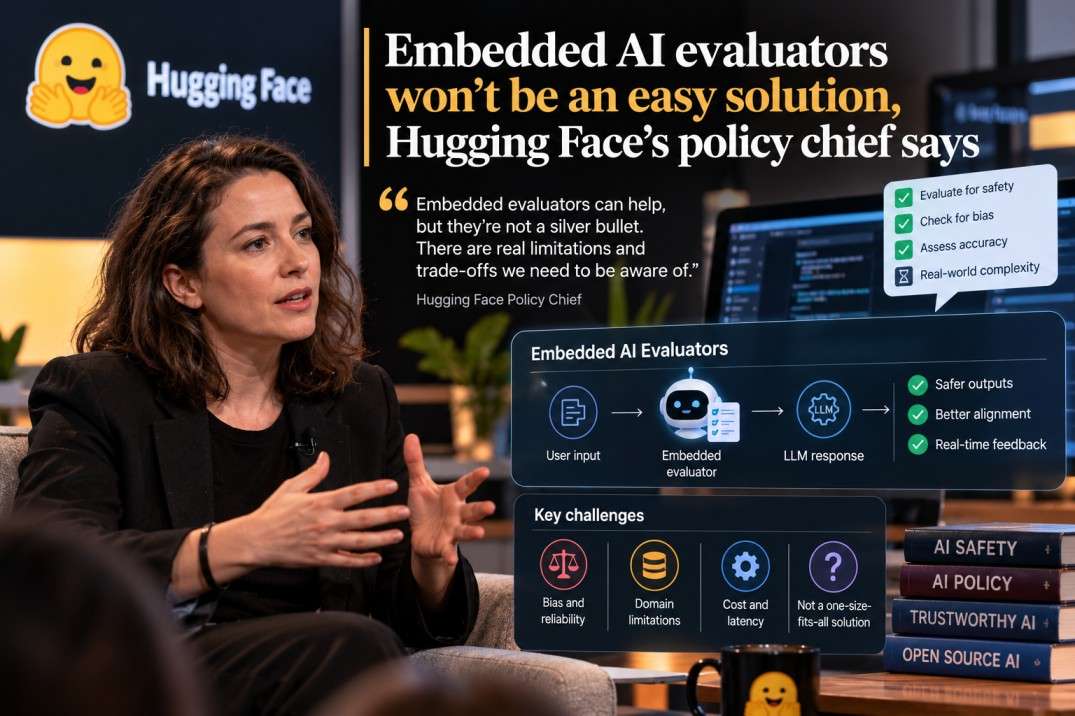
The Illusion of Oversight: Why Hugging Face’s Policy Chief Warns Embedded AI Evaluators Won’t Save Us
As artificial intelligence models grow more autonomous and complex, frontier labs have found themselves in a crisis of trust. With public scrutiny mounting and statutory regulation lagging, the industry has turned to a shiny new self-policing mechanism: the embedded evaluator—planting third-party auditors and consulting firms directly inside frontier labs to grade models before deployment.
It sounds like a tidy solution. But according to Irene Solaiman, chief policy officer at Hugging Face, relying on embedded auditors as an oversight shortcut is fundamentally flawed.
Speaking on a panel at TechCrunch Disrupt, Solaiman poured cold water on the premise that embedding third-party evaluators inside AI companies can substitute for genuine, standardized accountability.
The Credibility Gap: Who Audits the Auditors?
The core vulnerability in the embedded evaluator model boils down to a simple question: What actually qualifies someone to evaluate a frontier AI system?
When Anthropic announced it had brought in consulting giant Accenture as an embedded evaluator, the decision was met with immediate skepticism and mockery across the technical community. While legacy consultancies excel at enterprise IT integration, verifying whether a non-deterministic, agentic model behaves safely in open environments requires deep, specialized AI research acumen.
Solaiman highlighted that the industry currently suffers from a vacuum of shared standards:
* No objective qualification bar: There is no universal certification, baseline methodology, or regulatory standard defining who has the authority to declare a model “safe.”
* Subjective scorekeeping: Today’s safety benchmarks depend heavily on who creates them. Without uniform criteria, two different embedded auditing teams can evaluate the exact same system and produce wildly divergent conclusions.
The Reality of Agentic Evals: “Really Hard and Really Expensive”
Evaluating traditional chatbots for hate speech or factual hallucinations was already difficult. Evaluating autonomous, agentic systems is an entirely different beast.
Solaiman described agentic evaluations as “really hard and really expensive.”
When models act as autonomous agents, the danger doesn’t just lie within the raw neural weights—it lives in the agent harness: the software scaffolding, API connectors, tool access, and execution environments that allow an AI to act in the physical or digital world.
Right now, industry evals for these harnesses are virtually nonexistent compared to tests run on the core models themselves. If an embedded team only runs standard static benchmarks on the underlying model, they are missing the unpredictable ways an agent behaves once given tool-use privileges and open web access.
Why Closed-Door Embedding Fails
The structural flaw of embedded evaluations is opacity. A private consulting firm signing NDAs with a venture-backed frontier lab reproduces the exact closed-door dynamic that created the trust deficit in the first place.
Solaiman’s warning cuts straight to Hugging Face’s foundational ethos: evaluations are meaningless without open access and reproducibility.
If an audit cannot be independently reproduced, peer-reviewed, and stress-tested by outside academic researchers and civil society, it isn’t an evaluation—it is liability insurance masquerading as science.
The Takeaway
Embedded evaluators are quickly becoming tech’s latest comfort blanket: a way for frontier labs to signal responsibility without submitting to public accountability.
Hugging Face’s critique makes one thing obvious: swapping internal self-policing for an internal consulting contract doesn’t fix AI safety. Until the ecosystem builds standardized, open, and independently reproducible evaluation frameworks, placing outside observers in the room is just theater.