
The “Claude Tax”: Why Anthropic Is Hiring Fewer Juniors and Spending More Time in Meetings
For years, the promise of generative AI was ruthless efficiency: write code in seconds, automate boring admin, and eliminate the endless corporate slog of talking about work instead of doing it.
So what does work look like inside one of the frontier labs actually building these models?
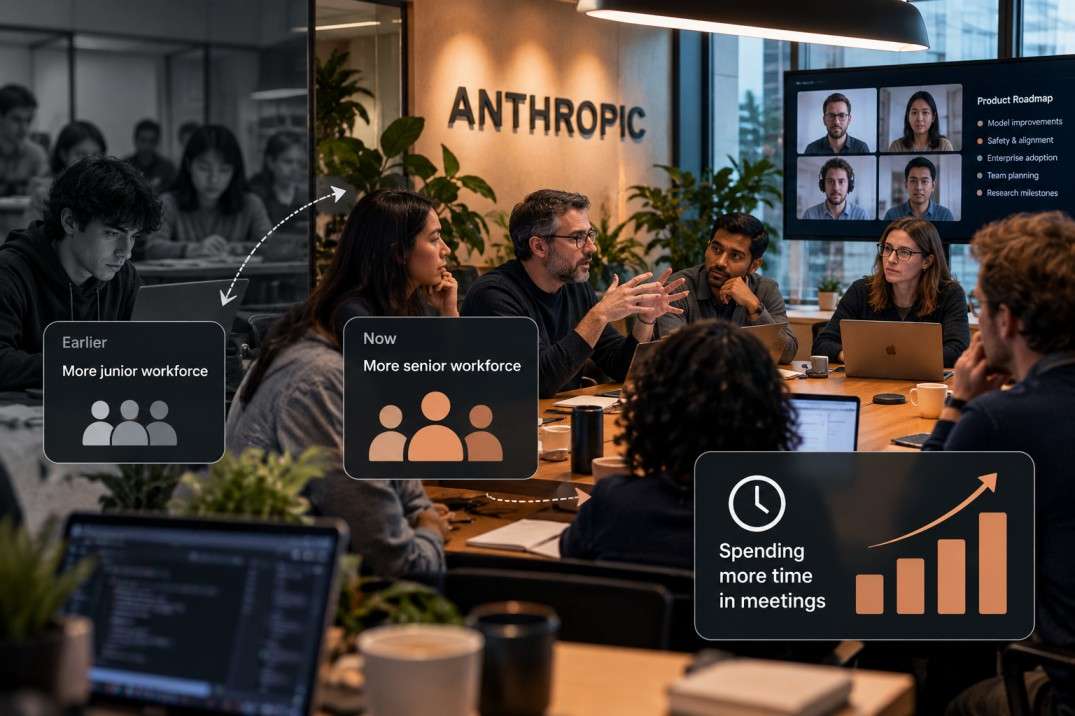
According to internal workforce data released by Anthropic, their employees are spending 20% more time in meetings across the company (and 16% more among technical staff), while junior technical hires have collapsed from 27% to just 9%.
At first glance, it sounds like an ironic punchline. But look beneath the surface, and Anthropic’s changing floor plan is offering an early glimpse into what happens to a company when AI takes over execution: the bottleneck moves from doing the work to deciding what work is worth doing.
1. From Writing Code to “Managing Claudes”
The most revealing metric in Anthropic’s disclosure isn’t the meeting hours; it’s what employees say they’re actually doing. In an internal survey, 20% of Anthropic staff reported that their daily responsibilities shifted from doing manual tasks to “managing Claudes.”
When autonomous agents and coding models can handle boilerplate scaffolding, automated testing, script generation, and documentation drafting, the speed of raw production explodes.
What disappears, however, is the classic entry-level rung of the corporate ladder:
* The death of routine tasks: Junior developers historically cut their teeth on bug tickets, straightforward refactoring, and basic feature modules. Today, models handle that baseline layer in seconds.
* The rising bar for experience: If an AI agent can generate 500 lines of functional code in three seconds, you don’t need three entry-level engineers typing it out. You need an experienced architect who can look at those 500 lines, spot architectural debt, verify security boundaries, and know whether the design scales.
As a result, Anthropic’s hiring bar has drifted heavily toward seniority—not because they don’t value fresh talent, but because automated execution demands senior-level judgment.
2. The Meeting Surge: Why Alignment Replaces Execution
If AI is saving everyone hours of hands-on keyboard time, why are calendars filling up with video calls?
Because execution is cheap, but direction is expensive.
When an engineering team builds manually, the natural friction of writing code forces a slow, deliberate pace. When AI agents can produce functional prototypes overnight, an organization risks producing massive amounts of high-velocity garbage if teams aren’t perfectly aligned.
Anthropic identified “human attention, trust, and judgment” as the new operational bottlenecks. More meeting time isn’t necessarily bureaucracy run amok—it is the direct consequence of human coordinators needing to:
* Debate strategy, intent, and product direction.
* Review and audit the torrential output generated by AI workflows.
* Resolve edge-case ethics, safety guardrails, and customer alignment where machine models have zero intuition.
In an AI-augmented company, the work isn’t typing in an IDE. The work is sync-up, consensus, and governance.
The Uncomfortable Reality of the AI Workplace
Anthropic isn’t an outlier; it’s a test balloon for the rest of the knowledge economy.
The emerging blueprint of the modern tech company isn’t fewer humans doing the exact same jobs faster. It’s an organization of senior conductors managing digital fleets.
That creates two critical industry questions:
* The Apprenticeship Crisis: If entry-level positions plummet to single digits, where do tomorrow’s senior engineers and managers learn their craft?
* The Calendar Paradox: If the end state of automating manual labor is spending all day in back-to-back alignment meetings, did AI liberate knowledge workers—or just turn everyone into middle managers?
Anthropic’s numbers make one thing clear: AI will write the code, but you will still have to show up to the Monday sync to decide what it means.